
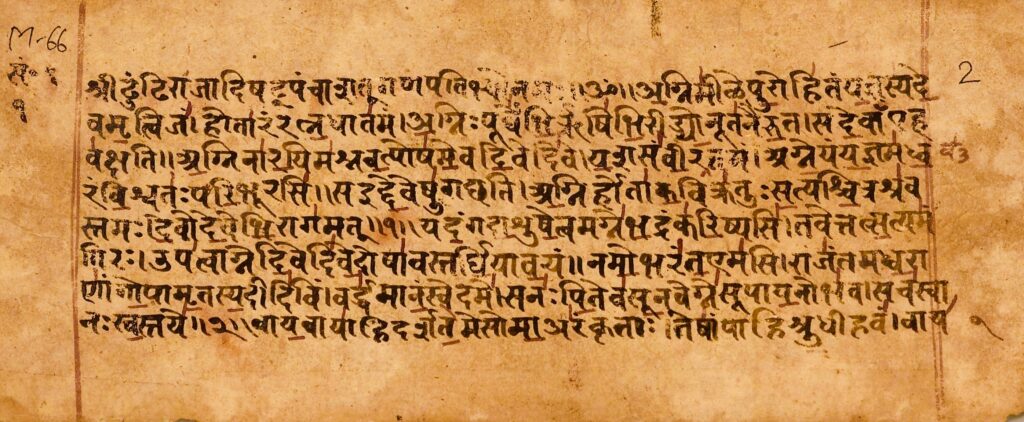
When one thinks about Indian tradition, one would definitely associate it with the rich Sanskrit literature beginning with the Vedas that are believed to have been composed even before 5000 BC. Over many thousands of years, the Vedas travelled orally till it was written down somewhere around 1500BC. It was in Sanskrit that the original Upanishads, Ramayana, Mahabharata were written. This Sanskrit-Vedantic tradition is often referred to as the Great Tradition, something that had belonged mostly to the elite or thinking class of India.
But to really get the whole picture of Indian tradition, one can never forget the Little tradition (the one that belongs to the folk society or non-elites). While the Vedas resonate with the sound of unity, the folklores become the window to the diversity that India is.
Diversity needs to remain if true unity is to be reached.
But this diverse world often remains hidden, away from the limelight. A true traveller visits the city and walks on the highway but will never hesitate to explore the bylanes and hamlets as well.
A folklore from one such bylanes can be added to explain this further…
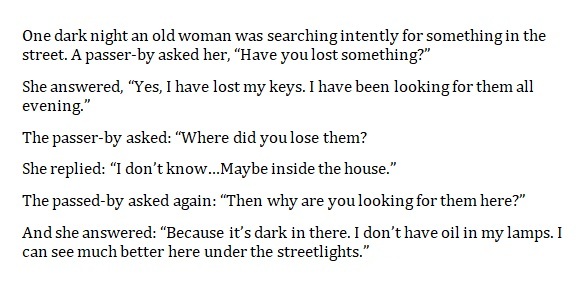
Let us not be like the old woman. It is in the dark that the key lies. We cannot just keep looking for culture codes in “well-lit public spaces”. The key might be hiding in the nondiscrete earthy living of the common people and in their practical wisdom.
But be it the Great Tradition or the Little, there is one theme that is well-evidently common everywhere in Indian literary tradition. This one theme is – MYSTICISM. The search for the Truth holding the mystery of life and death – has remained present in the land of India inspite of all the ravages and revolutions that it has gone through.
Here is another folktale from the land of mysticism that reminds us of the true purpose of life…
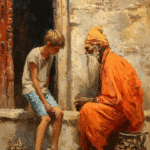
There was a young man, a scion of a noble family, who was deeply interested in spiritual matters. He was humble and courteous to all who were known to be seekers of truth.
One day he met a ‘holy man’.
The holy man said: “Dear young man, it is time you have a guru. That will lead you along the right path. I can assure you that I have achieved enough to be your guide. If you so wish, I can give demonstrations of my merits.”
“Can you? What kind of demonstrations are they, Sir?” asked the curious young man.
“I can remain buried under the earth for days together; I can live under the water too for days at a stretch and, for your confidential information, I can even fly! I have achieved such feats through strenuous practice of Yogic and Tantric practices for years!” stated the holy man.
The young man responded: “Your achievements are impressive. But there are many others I know who can perform these feats. They are right here. Why not accept them as my guru?”
The holy man looked surprised and a bit agitated. He shouted back: “I challenge you to show them to me.”
The young man replied very quietly, “Come with me Sir.” He then took the holy man to his garden.
He dug a little into the earth and showed a worm. “Look here, Sir, this can remain under the earth for years, what to speak for days!”
Drawing the holy man’s attention to his pond, he said, “Look at those fish and that tortoise over there. They can remain under the water all their life.”
Then pointing at a bird, he said, “Here is the one who can perform the other feat; it can fly!”
The young man continued, “All these beings are in tune with their core truth. But I wonder if the core truth of man is flying, living under the earth or water. My guru will show me the path of Truth for which human beings have come to Earth, for which I have come to Earth.”
The holy man stood flabbergasted.
“Sir, what I need is to feel closer to the Spirit, that Self within me. That is the only feat I care for.” explained the young man.
The ‘holy man’ knelt down before him and said, “I have met my guru!”