

An Indian Folktale
Guru Ananda, like most of the gurus, had disciples among the householders, along with the students who lived with him.
Once in a while the guru camped in such villages where a large number of his householder disciples lived. One such village was Mahigram. He was camping there with a dozen or so of his students.
In the village Mahigram, almost all the villagers were devoted to him. Among them was Ravi, a grocer. He was a young man, quite healthy, strong and stout. He was reputed to be proud and rude, but he rarely met with any opposition. Needless to say, that was because everybody feared him.
That is why, it was a big surprise to everybody when, one morning Ravi was found to have died in sleep. There was no apparent cause for his death. He had never complained of any feeling of uneasiness nor had he any mark on his body to suggest any external injury or attack from any quarters.
The guru himself grew quite curious because this happened during his stay in the village. He began an enquiry. He talked to all those who had met him or had purchased anything from his shop the previous day. They all certified that he was hale and hearty.

“One had to see him when he took Shankar to task while closing his shop in the evening. His words were like cracks of thunder. Who could have thought that such a strong voice would fall silent forever in a few hours?” remarked one of the villagers.
The guru straightened up. “What did you say? He took Shankar to task, did he? Which Shankar do you mean?” he asked.
“Shankar, your student,” replied the villager.
“Why did Ravi take Shankar to task?” queried the guru.
“An item disappeared from Ravi’s shop when nobody except Shankar was nearby. Ravi suspected Shankar to have stolen it. But I must say that Shankar showed exemplary nobility. He never got angry, never uttered a word. He denied the allegation in a soft manner and did nothing more. That was great because being stronger than Ravi, Shankar could have taught him a lesson had he so wished!” reported the village who was present during the incident..
“Hmm!” The guru closed his eyes for a moment. Then he summoned Shankar.
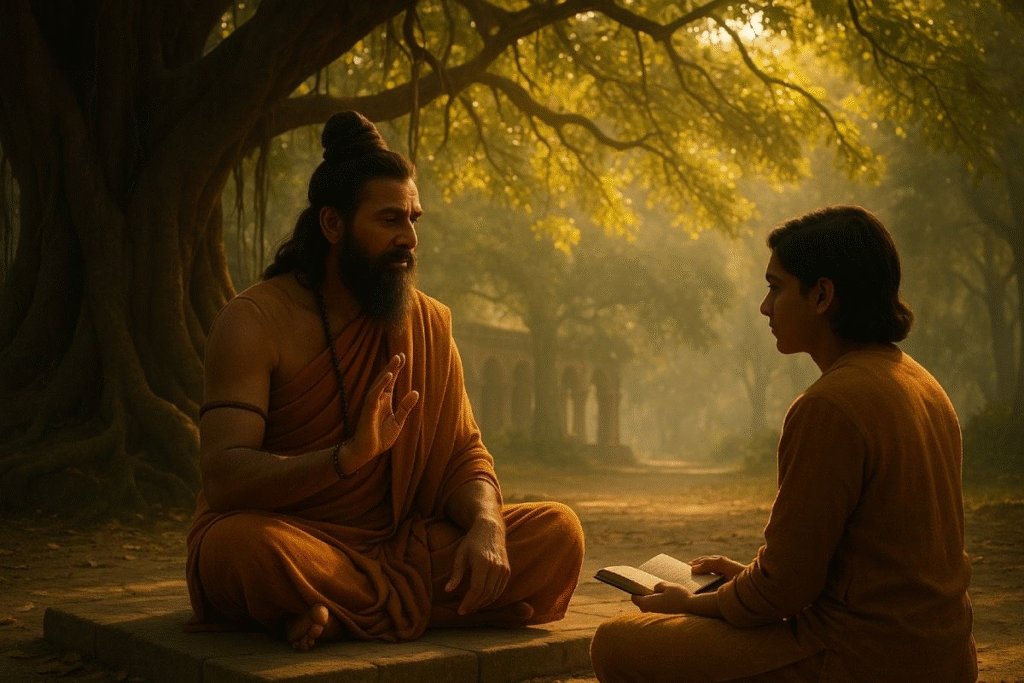
“How did you react when Ravi abused you?” the guru asked.
“Believe me, Guru, I did not utter a word of protest!” said Shankar.
“I believe you. But tell me how you reacted in your consciousness,” the guru asked Shankar.
“I felt a deep anguish. In fact, I felt like giving him a slap. But I controlled myself,” stated Shankar.
“You controlled yourself so far as your action was concerned, but not your anger. Right?” The guru wanted to confirm.
Shankar did not contradict the guru.
“Then?” the guru asked.
“I retired into my room and wept and….” saying this Shankar fell silent.
“And directed your wrath silently towards Ravi!” said the guru.
There was silence. The guru then said again:
“How much I wish that you had slapped him! That would have released your wrath at the gross physical plane. You should have refrained from slapping him only if you had no wrath in your consciousness. You merely refrained from the physical expression of wrath, not from wrath itself. And when you directed your anguish in silence towards him, it became a formidable occult force-and gave him a blow and finished him off! What a pity!”
The story explains that a mechanical restraint of physical violence does not mean much from the spiritual angle. People can do most grotesque violence under the guise of non-violence.
But the case of Shankar and Ravi is not limited to this truth alone. It unfolds an occult law – how genuine anguish can change into a terrible force of nemesis, how inner violence can become an energy and bring an invisible blow!