

Human beings have strangely failed to recognize the fact that diversity is the most natural way of life. Not everyone is born in the same way and the same rule will not apply to everyone. But we tend to somehow ignore this easy truth and put our effort into “rectifying” and smoothening out the differences.
It probably comes from a belief system that there is only a very definite way of living life. Anyone or anything outside it has to be shaken, broken, and squeezed to fit into a limited space of “acceptability”. And ofcourse all efforts are to be made by those who are “born with different abilities”…
The reign of modern science has resulted in making us look at the world and knowing the truth on a quantitative basis. Everything is determined by numbers. We seem to judge everything on a majority-minority scale. And that is how trends are followed, elections are won and researches are validated.
But life is essentially qualitative. Truth is beyond numbers. Every being is born with it’s own unique truth. Nature is endlessly creative and it manifests itself in infinitely unique ways. To discover our own uniqueness and to fully bloom in them is, perhaps, the greatest purpose of our life.
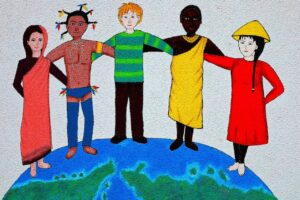
Inspite of this, as a human race we do have an inherent urge to communicate and thrive in the collective too. We want to belong. We do want to form meanings of life together, in unity.
We are forever caught in this conflict between individual becoming and collective belonging. This confusion sometimes leads to foolish and dangerous mistakes. Sometimes we end up believing and upholding ideas of UNIFORMITY thinking that those will lead us towards UNITY.
But ideas of UNIFORMITY mostly translate into unpleasant compulsion.
And in an ironical way, often such steps are taken with good intentions…
***
There was a period in our history when deaf and mute children were stigmatized and considered unteachable simpletons. Even there had been cases of using extreme methods as remedies of the so-called “disorder”.
It was a Spanish priest named JUAN PABLO BONNET who first attempted to change this by formalizing sign language for the deaf. Juan was appointed as a tutor of Luis, a Spanish Duke’s deaf and mute son. Juan developed a system of hand signals and gestures corresponding to the alphabets while teaching Luis. In 1620, Juan published a manual outline of his method.
In 1760, the first free school for the deaf and mute was founded by a French clergyman and philanthropist called Charles-Michel de l’Épée in Paris. The idea germinated in him when he saw two deaf girls in a Parisian slum effectively communicating with each other using hand signals.

But in the late 19th century a new approach was introduced for the deaf and mute students. This was done on the grounds that sign language keeps the deaf and mute students away from making an effort to learn the language of the non-deaf community. This in turn makes them very different and they fail to include themselves into the mainstream society.
The new approach to educate the deaf and mute was called Oralism. It focused on lip reading and speech therapy. There seemed to be quite a bit of logic and sense in this new approach as it focussed on bridging the gap between two different worlds – one of the deaf and the other of the non-deaf. However, what did get ignored is the fact that the new approach stripped off authenticity and blocked the path of natural development of those who use their hands to create meaning.
Oralist schools reigned the whole deaf education scene for almost a century. During this period, sign language was banned from the classrooms. Deaf teachers (who were experts in sign language) were gradually replaced by hearing ones. So fervent was the hostility to sign language that there are documented cases of deaf pupils having their hands tied behind their backs or to the legs of their chairs to discourage them from communicating by hand.
Inspite of such an aggressive approach, no positive result was obtained towards integrating the deaf children with hearing society. Instead the deaf children lost their own readily understandable language which they could spontaneously create with their hands.
In the 1970s, damning reports revealed the ineffectiveness of the oralist approach. Sign language was inevitably re-introduced as the basis of deaf education and communication.
***
The history of sign languages will not be complete without the mention of a love story which has perhaps been inscribed on it with pure gold.
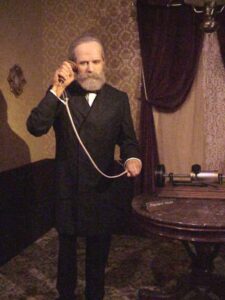
Alexander Graham Bell is best known as a revered scientist, engineer and the inventor of the telephone. However, he was also an ardent advocate of the Oralism movement in deaf education.
Bell’s father, Alexander Melville Bell, had been the creator of the Visible Speech method of phonetic notation, which tracked the position of the lips, tongue and throat in producing speech sounds. This method was originally designed to teach correct elocution (something that became an obsession during the Victorian period). This Visible Speech method was later used to teach the deaf community to speak by Alexander Graham Bell. In 1872, Bell opened the School of Vocal Physiology and Mechanics of Speech in Boston to promote his father’s teaching methods.
Ofcourse, Graham Bell didn’t for once feel that he is promoting something which can go down in history as “dark ages” of deaf education. In fact, he himself became a private tutor to many deaf and mute students. Heller Keller was one of them.
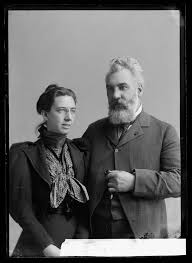
Another of his students, Mabel Hubbard, who had been deaf since the age of five, subsequently became his wife and the mother of his four children. Legend has it that Graham Bell undertook telecommunication experiments in an attempt to restore Mabel’s hearing. And today we realize that he was not only the inventor of the first practical telephone but he had essentially opened the path to a whole new way of human existence. Today’s smartphone is nothing but a progeny of Graham Bell’s telephone.
The story of Alexander Graham Bell and his wife Mabel is a testimony of love overpowering everything. From the time of Mabel’s courtship with Graham Bell in 1873, until his death in 1922, Mabel became and remained the most significant influence in his life.
They both had inability in one way or the other. If Mabel lacked the ability to hear, Alexander too lacked the ability to understand that hands are natural organs of communication for the deaf.
But what they were abundant in was love. Their silence, inspite of its painful existence, never closed their hearts to new possibilities. Their story perhaps says it is only with love that gaps can be bridged, it is only love in which all signs, all words, all silences and all differences become ONE.