
An Indian Folktale
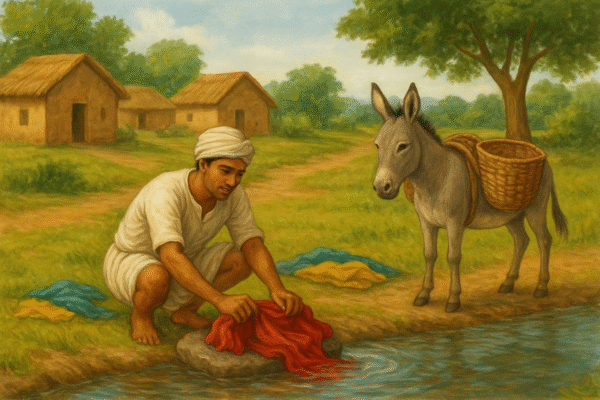
Once upon a time there lived in a village a washerman. Every day he had to pass by the house of a priest who taught the village boys.
One day when he was passing that way, he heard the priest saying, “Naughty boys, what are you? I have turned donkeys into men.”
The washerman was amazed on hearing this. In the evening when he went home, he told his wife what he heard and said, “Should we not get our donkey turned into a man by this priest? He will be like our son who will look after us when we get old and infirm.”
His wife, a simple woman, was pleased to hear this and said, “It’s a good idea. Be quick, go to the priest tomorrow itself.”
The next morning, the washerman went to the priest’s house, paid his respects and said, “Sir, we have no son or daughter. We have only this donkey. We shall ever remain grateful if you make him a man.”
The priest was taken aback at first. He said, “How can a donkey become a man? Who put this silly idea into your head?”
The washerman bent low, caught hold of the priest’s feet and implored, “Sir, I heard with my own ears yesterday that you have made men out of donkeys. Do not refuse me.”
The priest was clever. He realised that the washerman was stupid and he would not listen to reason. He said, “Look here. It’s not easy to convert a donkey into a man. It requires a lot of hard work. It also involves some expenditure of about two hundred rupees.”
The washerman said, “I’ll give two hundred rupees. But do me this favour – make my donkey a man.”
The washerman went home and brought two hundred rupees and gave them to the priest. He also left his donkey with him.
The priest took the money and asked him to come after six months.
After six months when the washerman came, the priest said to him, “Where were you all this time? Your donkey has become a very intelligent well-read man and has become a teacher. He is now teaching boys of another village. I’ll give you his address. Go and meet him there.”
The washerman was happy and took the address from the priest. As he was leaving, the priest said, “Don’t forget to take with you your bag. The moment he sees your bag he will recognise who you are and come to greet you.”
When the washerman reached the other village, he saw a few boys seated before a teacher who was teaching them. He stood outside the class and kept looking at the teacher. As and when he caught the teacher’s eye, he dangled the bag before him. This happened a number of times. At last the teacher called him. The washerman was pleased that he had been recognised. The teacher asked him why he was showing his bag to him again and again.
The washerman flew into a rage and shouted, “Ungrateful wretch, you don’t recognise me? This is the same bag from which I fed grain to you. You don’t recognise your master? The priest has made you a man out of my donkey. Have you forgotten everything?”
The teacher thought this man to be mad and made the boys push him out and away.
The washerman felt greatly hurt. He cried and shouted and went back to the priest of his village and told him the whole story and requested him to transform that teacher back into a donkey again. He said, “I’ll give you whatever you want. I want to teach that son of an ass a lesson.”
The priest said, “Give me two hundred rupees more and come back after a week.”
When he called on the priest after a week he saw his donkey tied to a post in the priest’s house. At first he was happy to get it back and then he led it home, beating it all the way.
The message of the story is:
Faith is good but faith does not mean losing all practical sense. Believing in miracles that fulfil one’s absurd desires can never be called true faith.