
An Indian Folklore
A villager had seven sons who were married one after the other, in order of their age. The wife of the youngest son, though very young in age, had a wise head.
Seeing that the wants of the family were growing, she spoke to her husband, his brothers and to her father-in-law, “We have failed to make a good living in this village ; let us go away elsewhere so that we may live in happiness.”
The family accepted her advice and they collected their meagre household goods and left for a distant village.
The village where they arrived was in an uproar, for the queen had just lost her necklace. She had gone for her bath and had removed the necklace, and kept it near the well. A kite came down with a sweep and carried it off. The maids and the queen raised a hue and cry to make the bird drop the necklace but without success.
The kite got away with the necklace, but, strangely enough, dropped it where the family of the seven brothers and their father were resting. The youngest son’s wife saw the necklace. She took it and kept it with her.
The queen was very much upset at the loss. The king had it proclaimed with the beat of drums that whosoever found the necklace and brought it back would get five villages.
The youngest son’s wife heard the announcement and announced that she could get the necklace.
The villagers were amazed and quickly took her to the queen.
The king asked her, “My dear girl, have you got the necklace? If so, give it back and you will get five villages.”
The girl replied, “O king, I do not want the five villages but I want only one favour.”
The king told her, “Your desire shall be fulfilled if possible.”
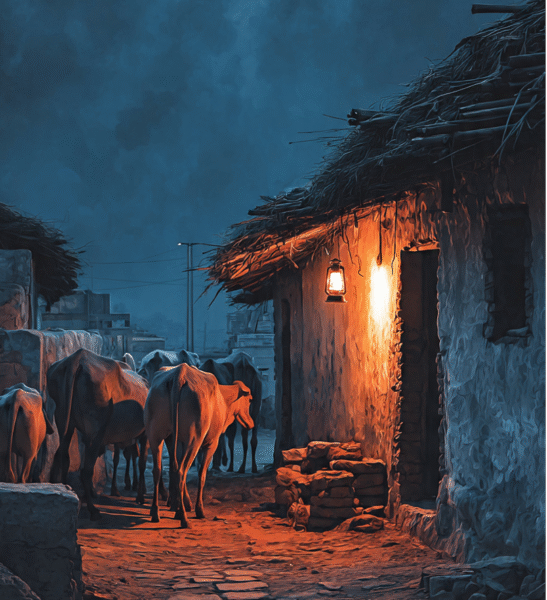
The girl said, “The favour I ask is that on the night of the cattle festival no one shall be allowed to light the lamp and on that day we alone will light one lamp.”
The king said, “This is a very simple request and I grant it.”
The girl handed-over the necklace and returned home. Her husband and brothers-in-law all thought that she was extremely foolish in not asking for the villages. The girl, however, assured them that all would be well and asked them to wait till the festival of the cattle which was coming only a week later.
On the festival day no lamps were lit in the village save in the house of this family. The bullocks, calves, he and she-buffaloes, goats and sheep were lost in darkness. Perceiving one steady light, all the cattle of the villages entered into the girl’s house. According to the customary tradition, whatever cattle passed her threshold of their own accord became hers.
In this way the family became very rich and spent their days in happiness. The girl explained to the family that not knowing the intricacies of running the villages, they would have been in great difficulty if they had taken the five villages. But as they knew how to manage the cattle and make money out of them, it was better to take the cattle. They all agreed that the young girl was extremely wise. There was no end to their happiness thereafter.
This story not only demonstrates the inherent quality of a woman to change the destiny of an entire family, but also tells us not all boons are to be accepted blindly. A thing that looks lucrative might turn into a burden. So all decisions must be taken after some contemplation and never with greed.