
An Indian Folklore
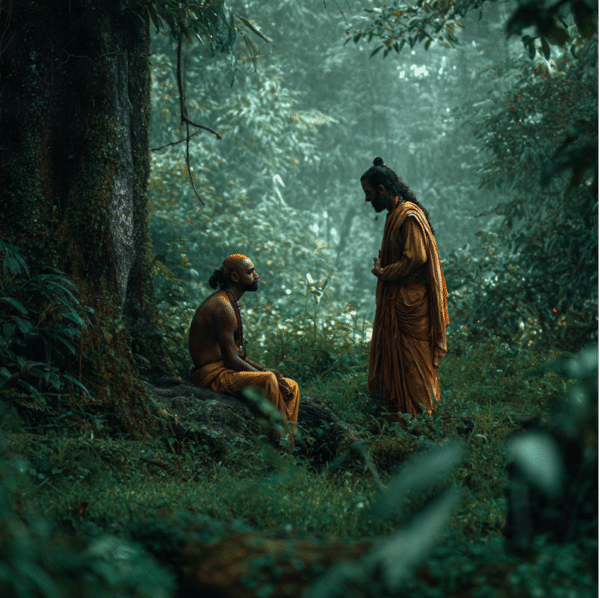
Once the great sage, Narada, who often wandered between heaven and earth, set foot on the peak of a mountain. He then joyfully began climbing down the mountain.
On his way he met a Yogi who greeted and asked: “My question is, when should God consider me worthy of meeting Him? My prayer to you is to put this question to Him and bring His answer to me when you descend on the earth next.”
“I will do so,” said Narada.
“God ought to know everything, but kindly do not forget to remind Him that I have practiced severe asceticism and austerities for years; I have achieved many a power. It was high time that I met Him!” pleaded the Yogi.
“I will convey your prayer to Him,” assured Narada.
He then resumed his journey downward. At the foot of the hill was a lake. By its side, in a small hut, lived a simple devotee of God. He came out of his but when he saw Narada and prostrated to him.
He said, “O Narada, will you kindly ask my Lord when will He allow me to set my eyes on His feet?”
“I will,” said Narada as he moved away.
A year passed. Narada happened to visit the earth again.
As he descended on the mountain, the yogi saw him, rushed out of his cave and informed him: “O Narada, in the meantime I have achieved still more powers through my yogic practices. Now, do tell me, how long must wait in order to he admitted to God’s presence?”
“Not very long. You have to pass through five more births and in your sixth life from now you will have great spiritual realisations. Thereafter you will meet God,” answered Narada.
“What?” exclaimed the yogi, “Still six more births? What for did I undergo all the strenuous and severe practices in this life then? All is dark, all is lost for me!”
“Have patience,” said Narada, but it is difficult to say whether the Yogi heard him, lost that he was in his remorse.
Narada climbed down the mountain, leaving the disappointed Yogi behind. At the foot of the mountain he met the devotee. He threw himself on the ground before Narada.
“My friend, I put your question duly to the Lord and he said that you must undergo a thousand more births in order to be with Him,” said Narada.
The devotee was euphoric. He said: “What! Only a thousand more births and I am there with my Lord! Infinite indeed is His Grace! It is only in His supreme compassion that He has decided to grant me shelter at his feet after only a thousand more births! Oh, how delighted, how thrilled I am!”
“Enough,” said Narada with a meaningful smile. “Follow me. It is high time you are gathered to His presence. He is waiting for you.”
Thus Narada led the devotee to the Heavenly abode of God.
The message of the story is:
Impatient yearning for spiritual attainment only keeps the seeker away from feeling closeness with the Divine. But when one is whole-heartedly devoted, the path and the destination both become equally joyful. To live as an offering has always been the core of the Indian psyche. The offering could be towards work, towards God or towards Nature.
The path of penance or ritualistic paraphernalia of worship often becomes a heavy burden, an external trapping in which the limited self gets too caught up and finds it difficult to identify with the Unlimited Existence of the Eternal Spirit.
We are nothing but parts of the Whole, the Totality of the Universe.