
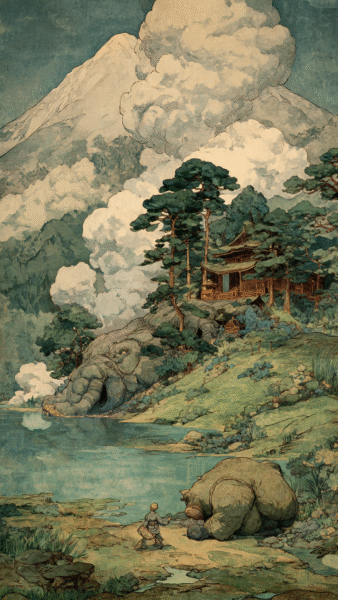
A JAPANESE FOLK-TALE
Long long ago in Japan, there was a small state ruled by a young feudal lord who hated old people. He felt after people turned sixty-one, they became a huge nuisance as they could neither work nor think.
So he issued a decree, and threatened that whoever broke it, would be punished most severely. The terrified people, weeping and sorrowful, were forced to take their old parents when they turned sixty-one, to the dense forests on the high mountain near the city, and leave them in the cold and rain, to the mercy of wild animals. So this mountain came to be known as The-Mountain-That-Ate-People.
Soon there were hardly any old people left, and the feudal lord was very happy. He thought now his state will prosper as the young and energetic people will be very productive and there will be no trouble with aging parents and grandparents.
Now, there was a farmer who lived with his mother and loved her dearly. He never did anything without her advice. But alas, everyone grows old with time. Soon his mother too turned sixty-one.
One day his mother called him and insisted on taking her to the mountains. She said death is inevitable and destiny cannot be evaded. It is better not to delay what needs to be done as the heartless lord might punish them even more ruthlessly. But the farmer just could not imagine leaving his mother alone in the dark and desolate forests. He started weeping bitterly.
The farmer said, “Never, never will I be able to take you to the dreadful forest and let you die there. I will gladly accept any punishment from the feudal lord instead.”
So the son worked hard day and night and dug up the floor within the house. He made a small room under the ground, hid the old mother in there, and looked after her.
During the day he tended his fields cheerfully as usual, never letting anyone know his dreaded secret.
A year passed … and yet another … One day, the mighty overlord of the neighbouring state, came thundering with his army and horses and waged war against the feudal lord, defeating him.
The defeated feudal lord pleaded mercy. Again and again. The victorious lord at last agreed and said, “I will give you a puzzle to solve. You will be given enough time and liberty to discuss with your subjects. If you are able to solve the problem correctly, I will spare your kingdom.”
And then the victorious overlord said, “So here is the riddle: Take a thousand strings, tie them into a bundle, and burn the bundle to ashes. Then bring the bundles to me completely intact.”
When the feudal lord heard the problem he was utterly dumbfounded. Calling his nobles, he sent a proclamation throughout the land that whosoever could solve it would be richly rewarded.
The farmer heard of the riddle too. When he returned home and told his mother, she laughed heartily. And then she said:
“Don’t worry son, for I will tell you. Make a bundle out of a thousand strings, soak it in sea water, and dry it well in the sun. Even if this is burnt to ashes, it can still be carried intact to the mighty overlord.”
The farmer ran to the court of the feudal lord and bowing low, told him what his mother had said. How thankful and relieved the lord was! He praised the farmer, and gave him lots of money and lovely presents.
After some time, the great overlord sent a messenger to the feudal lord with another problem, which was much more difficult. The messenger said:
“My lord has another riddle for you to solve. Answer this correctly, then your land will be free. So the riddle is: How is it possible to pull a silken thread through a narrow pipe with seven bends?”
The feudal lord sent a proclamation across the land again. Again the farmer hurried home to tell his old mother, hidden away in her little room.
“It’s very simple, my son,” said the mother. “Let our master get a narrow pipe made with seven bends. Place it on the ground, and put plenty of sugar at one end. Then tie a silken thread round a large ant and release it at the opposite end. The ant will pull the silken thread through the pipe, not just through seven bends, but through seventy!” she added laughing.
Again the farmer ran to the feudal lord and the delighted lord rewarded him with gold and silver.
Time passed and yet once more, the wicked overlord sent his messenger to harass the feudal lord with the hardest problem of all. The messenger from the overlord announced:
“The great lord wishes you to make him a drum that will play by itself.”
“Who is there that can tell us how to make such a wondrous drum and save our lives and land?” the feudal lord wailed and again sent a proclamation. The farmer turned again to his mother for advice.
The mother immediately came up with the answer. She said, “Make an ordinary drum and put some bumblebees inside, before covering the sides with paper. Take it to the overlord, and it will play merrily without being touched.”
The excited farmer ran to the feudal lord to tell him about the solution. The lord was overwhelmed with joy. But suddenly, he stared hard at the young man and asked: “Surely, you cannot be so wise, to think of the answers all by yourself. Tell me honestly, who has helped you?”
This time the farmer spoke courageously with confidence, “My lord. It is indeed true that I have disobeyed you and have kept my old mother hidden away at home. But had she not been there, today our lives and land would have been at stake. It is really she who has given you the correct answers to these problems.”
The feudal realized at once the value of the great wisdom of old people and his folly in sending them away to the mountain to die. He immediately withdrew the cruel decree.
So from that day, no old people were ever taken to the-mountain-that-ate-people, and they lived happily with their children and grand-children.
Moreover, the powerful overlord, extremely impressed by the wisdom of the feudal lord and his subjects, gave up fighting, and the people lived together in peace and harmony.
In the prologue of the book IKIGAI, which is an international best-seller, the authors talk about “the extraordinary longevity of the Japanese”. Ofcourse, the book is about practical tips to keep ageing in a healthy and joyful way.
But one would be inclined to think, especially after reading this Japanese folktale, that probably culture too plays a role in the overall approach towards old age. Japan seems to have a more vibrant approach to old-age.
Instead of accepting old age as an inevitable “loss” of youth, the story is rather about celebrating the “gain” of wisdom that comes only with old age. The story does not hover over the typical concept of being “dutiful” towards old people and that is why the goodness of the son is not glorified. Neither is the motherly love of the old woman the main focus of the story.
The real protagonist of the story is the old woman’s practical wisdom.