A Bengali Folklore
A young king was stricken with impotence. He became bitter and unhappy. No doctor or medicine could restore to him the pleasures of potency, available even to the poorest man. The sight of beautiful women only made him sick with grief.
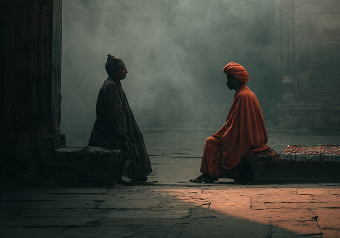
One day, word reached him that there is a dervish who could cure even incurable diseases. Hoping against hope, the young king made his way secretly to the dervish. When the dervish heard what ailed the king, he took out a small vial that contained a glowing elixir. He himself drank three-fourths of the elixir. Then gave the rest of the elixir to the king and instructed him to drink no more than one drop each morning for 3 days. The king did exactly the same and by the third day he became a tiger in bed.
The king enjoyed himself for many days and after that he calmed down a bit. Then the king started thinking about the dervish and his extraordinary powers. He thought the dervish drank so much of the elixir in one gulp, while he himself had only one drop a day and had become mad with desire.
So he went to the dervish again and after thanking him asked: “How did a holy man, a celibate like you, drink so much of the elixir and still remain calm?”
The dervish replied solemnly: “I will satisfy your curiosity tomorrow, if you live that long. I can see your death before tomorrow’s sunrise. But I will try and save you. Here, open your mouth.”
Saying this, the dervish took out another vial of elixir and emptied the whole bottle inside the king’s mouth.
The king went into a state of shock. The dervish asked the king to go home and disappeared into his hut.
King went back to his palace in a daze and even after seeing all the beautiful women trying to seduce him, he went alone to his room. The only thought that occupied his mind was his imminent death. He tossed and turned and rolled all night. Each bell from the tower clock felt like his death knell.
Atlast he could see the light of dawn. He felt like he had a new life. He hurried to the dervish.
The dervish was sitting outside his house. Seeing the king approach his hut he smiled and asked: “How did you enjoy the night with all the palace beauties?”
The king was shocked at this question. He said: “Enjoy the beauties! You are telling this to me, who had to die this morning? What are you saying?”
The dervish answered quietly: “I knew that this is not your time to die. Yet I frightened you just to give you a practical demonstration. This is the answer to your question about the elixir and its inability to arouse desires in me. You drank the entire bottle of elixir yesterday yet it failed to rouse your lust as your mind was thinking about the approaching death.”
The dervish continued: “Your Highness saw the phantom of death for only one night, but I see it dancing before my eyes every moment. That is the reason my life’s aim is to prepare for death and so I welcome and cherish it at all times in my mind.”
Saying this, the dervish bowed and vanished.
In the first instance, “preparation for death” sounds rather morbid and dark. But if we think deeply, the morbidity and darkness actually lie in the fear of death and not in the phenomenon of death.
Death is the most natural occurrence. One who is born will have to die. There is no truth greater than this.
The path towards Immortality, which has been the covert or overt seeking of man since time immemorial, begins from being liberated from the fear of death. Hence the holy man in the story says, “My life’s aim is to prepare for death, and so I welcome and cherish it at all times in my mind”. The preparation lies in cherishing and not fearing death.
Modern psychology as of now believes that escape from fear of death is impossible rightly for the reason that one’s ego self will always be in control of its consciousness.
However, Indian spiritual thought has always been about striving to overcome the ego. Fear of death is conquered with the experiential knowledge of the Eternal and liberation from the understanding that one’s journey is limited to the space and span of “self”..
The great Bengali sage Ramprasad Sen beautifully expresses this effort and process of liberation with a poem:
"Tell me, brother, what happens after death?
The whole world is arguing about it –
Some say you become a ghost,
Others that you go to heaven,
And some that you get close to God,
And the Vedas insist you're a bit of sky
Reflected in a jar, destined to shatter.

When you look for sin and virtue in nothing,
You end up with nothing.
The elements live in the body together
But go their own ways at death.

Ramprasad says: you end, brother,
Where you began, a reflection
Rising in water, mixing with water,
Finally one with water."
Probably the meaning of Death is the expansion of our limited existence to the Infinite. Life can become a preparation for this Blissful transformation.