A Sufi story
Mulla Naseeruddin’s father was a highly respected man. A Keeper of a Shrine. Shrines are burial places of great teachers which then turn into pilgrimage for seekers and followers.
In the usual course of events, Naseeruddin could be expected to inherit this position. But soon after their fifteenth year, when he was considered to be grown-up enough to inherit the post, he decided to find his own path and seek his own truth.
“I will not try to prevent you, my son,” said the father. So Naseeruddin saddled a donkey and set off on his travels.
He visited the lands of Egypt and Babylon, roamed in the Arabian Desert, went to Samarkhand and Hindu-Kush mountains and kept travelling towards the East.
Naseeruddin was struggling across the mountain ranges of Kashmir, when his donkey, tired from all the travelling and extreme weather conditions, fell down and died.
Naseeruddin was overcome with grief for the donkey as the donkey was the only constant companion of his journey for the last few years. Heartbroken, he buried his dead donkey friend and raised a simple mound over the grave. There he remained in silent meditation. When he would open his eyes he would either weep or keep gazing at the valleys of Kashmir.
Now the travellers who kept passing that road saw this lonely figure and started talking among themselves:
“This must indeed be the grave of a holy man,” they said to one another. “Must be some great soul and that is why his disciple is mourning his death in this manner. He has been sitting in front of the grave for months”.
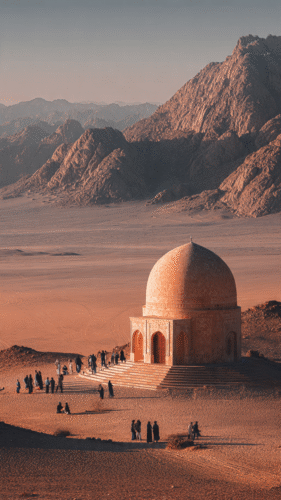
After some time a rich man passed that way and heard about the grave of such a great saint. So he gave orders for a dome and shrine to be erected on the spot. Other pilgrims terraced the mountainside and planted crops whose produce went to the upkeep of the shrine. The fame of the Silent Mourning Dervish spread until Naseeruddin’s father came to hear of it. He at once set off on a pilgrimage to the sanctified spot. When he saw Naseeruddin he asked him what had happened. Naseeruddin told him. The old dervish, Naseeruddin’s father, raised his hands in amazement and exclaimed:
“O my son, the shrine where you were brought up and which you left for this journey has exactly the same origin. It was raised in exactly the same manner, by a similar chain of events, when my donkey died, over thirty years ago.”
This story is said to be a profound allegory of man’s capacity for self-deception, rationalizing power, and tendency to be blinded by a fixed idea of religion or construction of an image of romantic spiritualism .