
An Indian Folktale
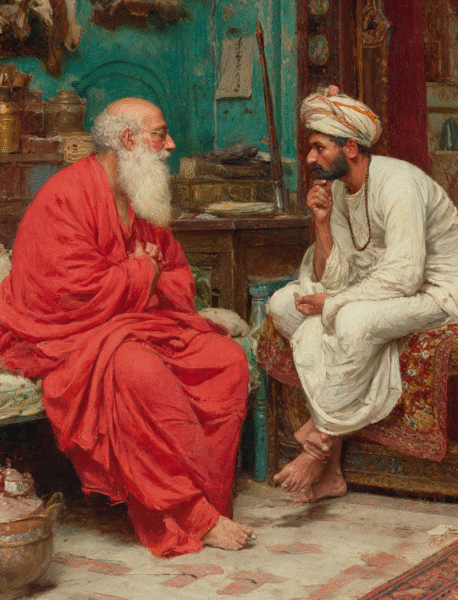
The good old zamindar had a guru. Once every year the guru would honour the zamindar by camping in his house for a few days.
Then the good old zamindar passed away. His son, Kishore, was not known to have much interest in matters spiritual. Nevertheless, he put up a show of devotion for the father’s guru whenever the guru came to visit his house.
Kishore’s wife, Lakshmi, however, loved and adored the old guru deeply. Perhaps that was the reason for the guru continuing to visit them.
The guru gave a discourse to the devotees every time. Kishore rarely attended it.
Once, however, Kishore was present during a discourse when the guru was explaining the concept of Oneness. Lakshmi was pleasantly surprised to observe her husband listening to the discourse with great attention.
The guru said, “In an enlightened state of mind, one does not differentiate between a prince and a pauper, or between a bar of gold and a clod of clay. He sees the presence of the One in everything. He loves and adores the One in all.”
Kishore inched nearer the guru. Indeed, his face recorded an unusual glow.
Was her husband verging on becoming deeply spiritual? Lakshmi wondered for a moment.
But she received a jolt in the evening when, on entering her husband’s room, she saw him embracing their new maid, Leela. At night she took her husband to task for his conduct.
“Ah, Lakshmi, I never knew that you were so unenlightened. It seems the guru’s words fell on deaf ears so far as you are concerned! For me, I do not differentiate between you and Leela, that is the state of mind in which I am!” replied Kishore with a smile.
Lakshmi sighed and kept quiet.
Afterwards, dinner was served. The guru walked in when Kishore had just sat down for dinner.
“I’m so happy to learn that you have grown enlightened! You don’t differentiate between one thing and another!” the guru commented.
“It is all your blessings, guruji!” said Kishore, feeling quite flattered. Then, looking at Lakshmi, he asked if the guru had already had his dinner.
“O yes, I have finished with mine. You may go ahead with yours,” said the guru.
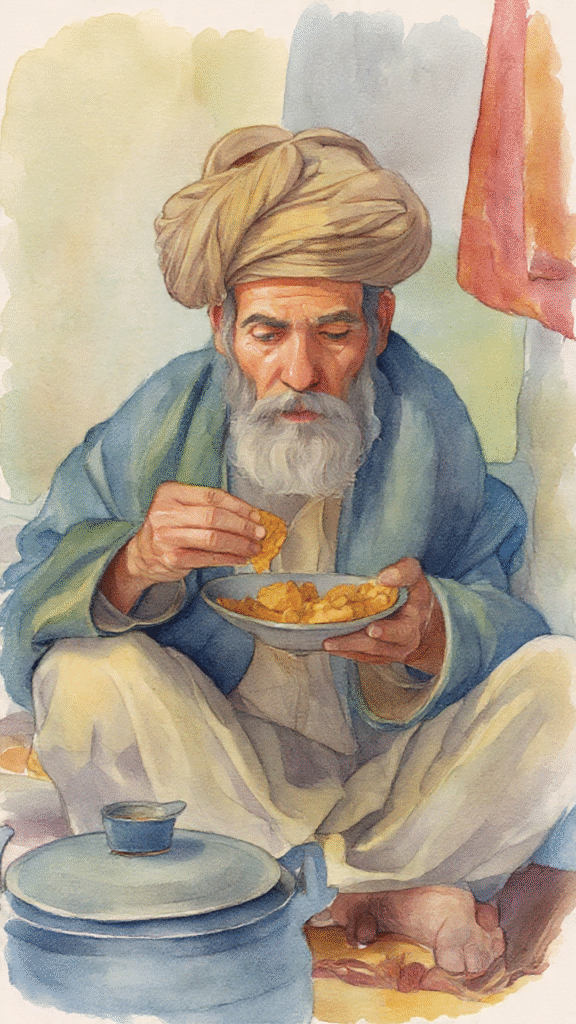
Kishore picked up an item that looked like a cake and clamped his teeth on it. His face showed surprise and displeasure.
“What’s this?” he asked Lakshmi.
“A cake!” came his wife’s reply.
“But it tastes like cow-dung!” exclaimed Kishore.
“It is cow-dung, of course, only baked!” replied the wife calmly.
Kishore sprang up. “What do you mean by offering me a cow-dung cake?” he shouted.
The guru who was quiet all this time said: “Look here, young man, it was on my instruction that she did so. I told her that her husband had obviously reached a stage when he cannot differentiate between cheese-cake and cow-dung cake. He has grown enlightened!”
Kishore stood still, speechless.
The guru patted him on the back and said:
“My son! It is easy to cite a doctrine but not easy to realise it. Worse still, it is easy to indulge in wrong things in the name of an ideal. You will earn the right to say that you don’t find any difference between Lakshmi and Leela only when you find no difference between cheese-cake and cow-dung, between gold and clay. And if you have reached that stage, you will have no attachments—either for this or that.”
Kishore nodded.
This humorous story is a perfect commentary on how often religious doctrines that were originally created for spiritual evolution or larger good of the society, are misused for the purpose of fulfilling one’s desire or for holding on to power. The consequence is exploitation and suffering of the mass. Curbing any kind of freedom against one’s will can never lead to spiritual progression. Rather it leads to repression and other forms of psychological crisis.