
A Folklore from Arunachal Pradesh
Urgelling Monastery with its beautiful setting in the higher reaches of Arunachal Pradesh, was considered the perfect place for young monks to build their patience. The snow-capped Himalayas surrounding the monastery not only provided the best view but also served as a reminder of man’s insignificance and microscopic size on Earth. Surrounded by the Himalayas and the Tawang Chu Valley, the monastery had been established in the fifteenth century and since then many Masters had taught many monks.
The present Master of that Monastery was wise and renowned in the entire region. But his pupils were a peculiar lot, and despite over a year of meditation, had found little reserves of patience within themselves.
One day, as the Master was holding a special session on ego and fear in the prayer hall, a bee entered the room. The students slowly began to move as the bee flew closer to them. The Master sensed that his sermon was being overshadowed by the buzz of the bee. He opened his eyes and saw some of his students attempting to dodge the bee, while others tried to swat it. The Master was ashamed of the lack of endurance in his students. His teachings had made little impact on them. He dismissed the class, telling his students that he was going to the meditation room and must not be disturbed while there.
After six days of non-stop meditation, the Master came out of his room and asked all the pupils to assemble in the prayer hall.
Once in the prayer hall the Master said to his students, “I seem to have failed you and myself every day of the last year. Seven days ago, I realized that I am a good monk, but I may not be a good teacher. As your master, I ask you to retreat to the higher reaches of Mount Gorichen, the house of the Kameng river.”
His students gasped — Gorichen was the third-highest peak in their region.
The Master added, “I want you to climb to Gorichen and come back only after you have mastered your thoughts. Remember, mastering your thoughts does not mean that you should not think at all. It means you should be able to absorb what you see, learn something from that and then control what you are thinking.”
The students had listened to their master in silence, but most of them had found his instructions harsh and bereft of any sympathy. This, however, was their fate till they achieved what their master wanted them to. As the last of the students walked out of the gates, the Master, standing tall on the roof of the monastery, called out, “Do not stop till you reach the top of the mountain. Observe and absorb everything on the way. Every solution will come from that.”
The Master’s students walked non-stop for days, making their way through thick vegetation, crossing small brooks and bigger ponds, dodging herds of cattle that rushed at them and protecting themselves from bad weather. But much before reaching the peak of the mountain, the students got too tired and hungry. They decided to return back to the monastery.
As they were walking down, the students came across a reed-thin man. Despite his lean frame, he looked strong. The man had a large deer slung over one shoulder. Clearly, he was returning from a hunt. The deer was so big that it seemed impossible that the hunter had killed it by himself and carried it all the way up the hill.
The hunter looked at the monks and asked, “Where are so many of you young monks going together?”
One of the monks replied, “Back to our monastery.”
The hunter smiled. He then said, “Very well! My name is Genkei. Can you do me a favour? Would you be kind enough to tell the Kameng river that Genkei needs water to wash and cook? I need her to come up to me.”
The monk students wondered if Genkei was mad, but they agreed to pass on his message to the river. When the monks got to the Kameng river, they said, “Hi, river. I hope you haven’t had a tough day. We have a message for you. Genkei has asked you to meet him at his house because he needs water to cook and wash.” They laughed, thinking that the river would find the request absurd. But suddenly, the Kameng started gurgling louder and louder, as if in response to the monks’ words. Before the monks could make sense of this, she turned and twisted, changing her normal course, and started crawling up the hill. The monks were shocked. They couldn’t believe their eyes. With mouths open in surprise, they stared at each other and wondered what to do.
“Let’s follow her. This has to be magic,” called out a young monk. They followed the river as she snaked up, until they arrived at Genkei’s house. Genkei was busy cleaning the huge deer, and he did not notice the young monks around him. He clearly hadn’t even noticed that the Kameng river had arrived at his house and was now flowing next to his garden like a spirited mountain stream.
“Genkei!” shouted Banzen, a tall monk in the group.
Benzene then continued saying, “What are you doing? Are you playing a trick on us? You haven’t noticed all of us surrounding you or this river that is making such an awful amount of noise in your garden. Tell us what your secret is.”
The other monks joined in, saying, “You have to disclose your magic trick to us. You can’t hide it any more.”
Genkei looked up and smiled. Leaving his veranda, he walked to the river, pressed his palms together and said, “Thank you for coming to help me, sister. I will return the favour with any help you want from me whenever you so desire.”
He then turned to the students and said, “If you have the resolve to do something, you succeed in doing it. All you need is absolute faith in yourself, and you can achieve even the most impossible things.”
The monks were not satisfied with the explanation. Together they screamed, “Teach us your secret, Genkei. We can’t wait to hear.”
Genkei pointed to the tallest rhododendron tree in the jungle that surrounded his house, and he told them that he learnt the secret by climbing the tree’s branches and sitting there in meditation for seven days straight.
“It’s not me. It’s this tree that has magical powers. That’s where I got it,” Genkei said.
The students looked up at the tree and asked Genkei how they could climb it when it was so imposing and tall. Genkei told the monks to use the other trees around the rhododendron to make the tallest ladder possible. This would help them reach the top. The students looked up at the tree and were perplexed. It seemed impossible to climb.
Genkei studied the monks and said, “Have you decided to give up? Ofcourse I knew you would. You people are weak and undisciplined. You could never do it.”
Challenged by Genkei in this most humiliating manner, the monks got to work. By late evening, they had made a very tall ladder, which could take them up to the topmost branches of the tree. Without looking at Genkei, who was sitting by the kitchen window, trying to stoke a fire, the monks quickly climbed up the branches. As soon as the last monk had climbed up, Genkei slipped out of his kitchen and took away the ladder from the base of the tree.
The monks were dismayed to see the hunter steal their ladder. They called out to him, “Genkei, what are you doing? Why are you taking the ladder? How will we come down now?”
But as they urged the hunter to bring back the ladder, they saw Genkei chop up the ladder into smaller parts and use some of the wood to feed his fire.
Given no choice, the young monks remained on the tree branches, meditating for days without food or water. When their hunger became unbearable, they pleaded with Genkei to help get them down.
Each time they pleaded, Genkei would shout out, “Jump if you want to. There is no ladder or rope here. Jump, jump, jump.”
The monks looked down and were filled with fear. They thought, “We’ll turn into a bag of bones if we jump.”
But they also knew if falling from the tree wouldn’t kill them, their hunger surely would.
Baizen, the tall monk, squeezed his eyes shut, gathered all the power in his lungs and shouted from his branch, “Genkei, I am ready to do whatever you tell me to do. Please, please have pity on us and help us.” His voice echoed through the mountains and valleys and reached the ears of Master in Urgelling Monastery.
As Banzen opened his eyes, he heard his master’s voice saying, “Observe and absorb.”
He then looked at Genkei, who, having heard Banzen’s plea, was shouting, “Jump, jump, jump!” He then added for the first time, “Jump and you shall fly!”
Suddenly, Banzen realized what his master had been trying to teach them – control your thoughts or your thoughts will control you. It was the same thing that Genkei had been trying to teach them when he had said, “If you have the resolve to do something, then you succeed in doing it. All you need is absolute faith in yourself, and then you can achieve even the most impossible things.”
Awakened and aware of his own strengths and the power of thought, Banzen decided to try the impossible – he was going to attempt to fly. He said to his fellow students, “It is better to try flying than die without trying.”
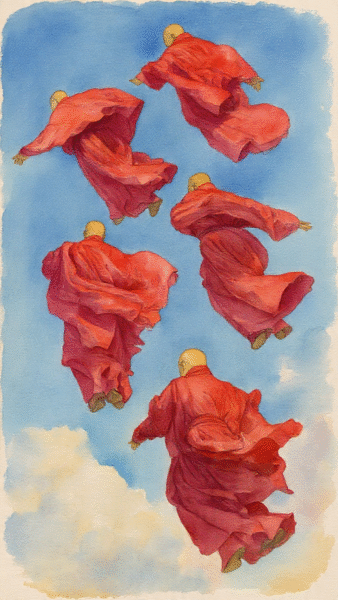
Saying this, he spread his arms out and jumped off the tree, his words still ringing in the ears of the other monks. Off the tree and swimming in the air, Banzen’s arms were spread like a bird’s wings, his crimson robes ballooning in the wind like a parachute, helping him sail. As Banzen skimmed the blue skies like a phoenix, he screeched, “I can fly!”
The monks could not believe what they were seeing. Banzen had flown like a kite and made a perfect landing on the ground. A moment later, they had all found not only the courage to follow Banzen in his flight but also the conviction to do so. One by one, the monks started jumping off the tree, flying like beautiful red birds, dotting the blue sky and leaving the tree bare. The monks had taken their flight to freedom. There was no fear of the unknown, fear of the impossible or fear of failure. Their egos would no longer punish them if they failed.
The Master’s last lesson on ego and fear was suddenly spattered across the sky, swimming and sailing.
Genkei looked up and saw the shower of red blossoms from above. He had done his job, fulfilling his promise to his old friend, the Master in Urgelling.
The Master’s students have been trained. As he watched the students glide, he remembered his friend’s words: “My students must learn that holding on to and nurturing an ego only keeps one chained and servile. To be absolutely free, one must lose ego and fear. You teach them that, Genkei.”
Realizing what they had just been taught by Genkei, the monks, once safely on the ground, bowed to him as a mark of surrender to the wise. They then turned around and started walking back towards the Urgelling monastery to their master.